
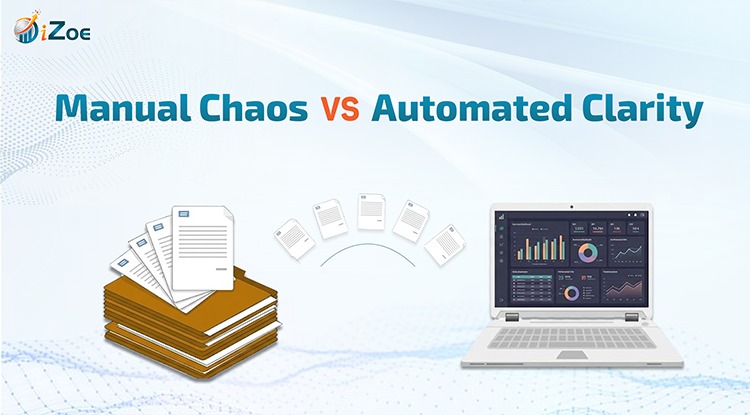
For many growth-stage businesses in India, the finance department often feels like a high-stakes emergency room. Invoices pile up, reconciliations never seem to end, and the month-end close feels more like a war room than a standard business process. As a business scales from ₹20 Cr toward ₹300 Cr, the manual methods that once worked in Excel or basic Tally start to buckle under the pressure.
This leads to a critical crossroad. One half of the market is sprinting toward accounting automation software, hoping for a “silver bullet” to end the chaos. The other half remains skeptical, fearing that automation might just accelerate the rate at which errors occur.
Is automation the solution to financial chaos, or is it simply a new way to create different, more complex problems?
Understanding the Shift to Automation
At its core, automated accounting is the use of digital tools and artificial intelligence to handle tasks that were previously manual. This includes everything from capturing data from a vendor invoice to matching bank statements with ledger entries. Instead of a finance executive spending four hours typing in data, a system can process hundreds of transactions in minutes.
However, the transition is rarely as simple as flipping a switch. To understand if it will fix the chaos, we must look at the trade-offs between the old-school manual way and the new automated reality.
The Case for Staying Manual: Control vs. Cost
Many founders and CFOs of Indian SMEs hesitate to automate because manual bookkeeping offers a sense of absolute oversight. When you enter a transaction yourself, there is no “black box.” You see the vendor name, you check the GST amount, and you catch discrepancies immediately.
Furthermore, manual systems have no monthly software fees. When cash flows are tight, a “free” spreadsheet feels safer than a recurring bill for a premium platform. For a business with very low transaction volumes (under 200 per month), the manual approach remains effective because the complexity hasn’t yet outpaced human attention spans.
Where Manual Methods Fail at Scale
The “control” of manual accounting is often an illusion that disappears as the business grows. Human attention has limits. Once a business starts dealing with multiple locations, hundreds of SKUs, and daily bank movements, manual errors multiply.
Data entry mistakes, such as transposing digits or missing a decimal point, become inevitable. More importantly, manual systems create “single-person dependency.” If the person who built your complex Excel trackers leaves the business, the logic often leaves with them. This creates a massive risk for any business looking to institutionalize its operations for an audit or a fundraise.
Turning Chaos into Clarity: The Impact of Automation
When implemented correctly, automation changes the fundamental physics of the finance team. It doesn’t just make things faster; it makes them more reliable. By using invoice processing automation and direct bank feeds, the risk of “fat-finger” data entry errors is virtually eliminated.
The real breakthrough is the transition from “historical” data to “live” data. Instead of waiting until the 15th of the following month to see a P&L that is already stale, automation allows for real-time MIS reporting automation. A founder can look at a dashboard on a Tuesday morning and see an accurate cash position, enabling faster, data-backed decisions.
Beyond speed, automation introduces a layer of systemic discipline. It ensures that every invoice is checked for duplicates and that GST numbers are validated before they hit the ledger. This proactive error detection means that by the time you reach month-end, most of the “cleaning” is already done. The result is a month-end closing automation experience that is quiet, predictable, and audit-ready.
The Verdict: Fixing the Chaos
The chaos in most Indian businesses isn’t caused by a lack of hard work; it is caused by a lack of “systemic trust.” Automated accounting fixes this by creating a single version of the truth. While it requires an initial investment in time and money, the cost of manual friction—delayed reports, audit queries, and missed reconciliation gaps—is far higher.
The goal should not be to replace the finance team, but to transition them from “data entry operators” to “financial architects.” Automation handles the volume, while the team handles the exceptions and the strategy.
At iZoe, we specialize in helping businesses navigate the transition from manual chaos to automated clarity. We don’t just sell software; we build a data spine for your business. By integrating Akounter AI, we specifically eliminate the friction of manual entry and GST accounting automation mismatches, turning your AP process into a streamlined, high-accuracy workflow.
We help you move away from “Chief Checker” roles and empower your team to focus on what matters: scaling the business with numbers you actually trust.
FAQs
1. Will automated accounting replace my current finance team?
No. It replaces the repetitive, low-value tasks like data entry and manual reconciliation. This allows your team to focus on higher-value activities like tax planning, working capital optimization, and financial analysis.
2. Can automation handle complex Indian compliance like GST and TDS?
Yes. Modern GST accounting automation is designed to validate GSTINs, check for duplicate invoices, and ensure that tax rates match the HSN codes before the data ever hits your books.
3. Is it expensive to move away from manual Excel-based accounting?
While there is a software cost, you must weigh it against the “hidden tax” of manual work. The time spent fixing errors, the cost of late-payment penalties, and the lack of real-time visibility usually cost a business far more than an automation subscription.
4. How long does it take to see the benefits of automation?
Most businesses see a significant reduction in “review time” within the first 30 to 60 days. Once the initial workflows are set up, the speed of month-end closing usually improves by 40% to 50%.
5. What happens if the software makes a mistake in categorization?
Automation should always be layered with controls. A good system flags exceptions for human review rather than blindly posting everything. You maintain the final say, but you only have to look at the 5% of entries that look “off” instead of checking 100% of them.

