
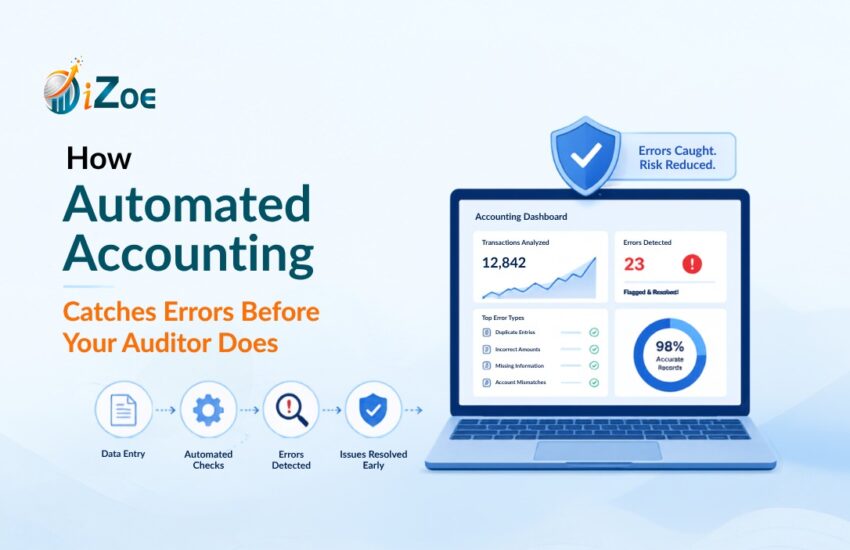
Here’s an uncomfortable truth most founders won’t say out loud: by the time your auditor flags an error, it has already cost you money, credibility, or both.
A duplicate vendor payment sitting quietly in your books for three months. A GST mismatch nobody noticed until the notice arrived. A stock entry that never reconciled with the bank statement. None of these show up on your dashboard. They show up in an audit report, or worse, in a bank due-diligence call , right when you need your numbers to look their best.
This is the silent tax every fast-growing Indian business pays for running finance on spreadsheets, memory, and hope. And it’s entirely avoidable.
The Real Cost of “We’ll Catch It Later”
Most founders assume errors in accounting are rare and small. They aren’t. They’re frequent, compounding, and invisible until someone goes looking ,usually an auditor, a bank, or an investor during due diligence.
Common silent errors that pile up in growing businesses include:
- Duplicate or missed vendor invoices
- GST and e-invoice mismatches between books and filings
- TDS deductions applied incorrectly or not at all
- Bank and cash reconciliation gaps that grow every month
- Stock valuation errors that quietly distort your margins
- Manual journal entries with no audit trail
Individually, each looks minor. Together, they mean your monthly MIS is fiction dressed up as fact, and you’re steering the business on numbers you can’t fully trust.
Why Manual Accounting Can’t Catch What It Can’t See
Traditional bookkeeping, even good bookkeeping, is reactive by design. A human accountant closes the books, and only during a review or audit does anyone systematically check for mismatches, duplicates, or missing entries. By then, the error is weeks or months old, embedded in reports that leadership has already used to make decisions.
Automated accounting flips this model. Instead of checking your books once a quarter, the system checks every transaction the moment it’s entered, flagging exceptions instantly, not retrospectively. This is the difference between finding a leak after the basement floods and catching the drip the day it starts.
How Automated Accounting Catches Errors Before Audit Does
This is precisely where Automated Accounting changes the equation. Instead of a once-a-quarter reconciliation exercise, AI-powered accounting software runs continuous control checks the same kind of checks a sharp CFO would run manually, except every single day, on every transaction, without fatigue.
An accounting software built for control not just data entry runs continuous checks in the background.
- Running invoice OCR + 3-way matching so no vendor bill is posted without verification against PO and GRN
- Flagging GST/e-invoice mismatches in real time, not at return-filing deadline
- Running automated bank and stock reconciliation daily instead of monthly
- Detecting duplicate entries, unusual variances, and revenue-recognition anomalies the moment they occur
- Generating an exception report so leadership sees only what’s broken, not a 10,000-line ledger
This is exactly the philosophy behind Akounter AI, Izoe’s AI-powered accounting engine. Rather than replacing your accounting team, it acts as a permanent second set of eyes reading every invoice, flagging every mismatch, and applying control checks that a human reviewing hundreds of entries a day simply cannot sustain.
Why This Matters More in 2026 Than Ever Before
India’s compliance environment has gotten less forgiving, not more. E-invoicing thresholds have expanded, GST scrutiny has tightened, and banks and investors now expect audit-ready books year-round not just in March. At the same time, AI-led finance automation has moved from “nice to have” to standard practice among startups preparing for funding, expansion, or acquisition.
As one industry maxim puts it in the finance automation space: audit readiness is built monthly, not in audit month. Waiting for your CA to find the problem is no longer a viable strategy it’s a liability you’re choosing to carry.
The Founder’s Real Choice
Every growing business eventually hits a wall where Excel and manual entry can’t keep pace with transaction volume. The question isn’t whether errors are happening in your books right now they almost certainly are. The question is whether you find out from an automated system this week, or from an auditor, bank, or investor next quarter.
Automated accounting isn’t about replacing your finance team. It’s about giving them the tools to catch what manual review physically cannot before it becomes a cash problem, a compliance notice, or a due-diligence red flag.
Don’t Wait for the Audit to Find What You Should Have Caught Months Ago
Every quarter you delay automation is another quarter of silent errors compounding in your books. Izoe Solutions helps founders and CFOs move from reactive bookkeeping to real-time financial control with Akounter AI, ERP, and BI systems built for how Indian businesses actually grow.
FAQs
What is automated accounting?
Automated accounting uses AI and rule-based checks to record, validate, and reconcile financial transactions in real time, flagging errors and mismatches as they occur instead of during periodic review.
How is Akounter AI different from regular accounting software?
Akounter AI, built by Izoe Solutions, layers AI-driven exception detection, GST/TDS validation, and reconciliation checks on top of standard bookkeeping catching silent errors continuously rather than only at audit or filing time.
Can automated accounting replace my CA or accountant?
No, it removes repetitive error-hunting so your CA can focus on strategy and judgment calls.
Is automated accounting only for large companies?
No, it’s most valuable for startups and SMEs, where one audit surprise can derail a funding round.

