
For most founders of growing businesses, the morning begins with a familiar but frustrating ritual. You open your laptop, head to a folder titled “Financials,” and open an Excel sheet that was supposedly updated last night. You look at the bank balance, compare it to the “Expected Inflows” column, and try to calculate your actual runway in your head.
By mid-afternoon, a vendor calls about an overdue payment you thought was cleared. By evening, your warehouse manager reports a stock shortage that the excelsheet didn’t predict. The “Cash Surprise” is not just an annoyance; it is a structural bottleneck that prevents you from making bold, data-backed decisions.
When your business was at ₹5 Crores, Excel was a superpower. It was flexible, fast, and free. But as you scale toward ₹50 Crores or ₹200 Crores, that same flexibility becomes a liability. Manual data entry leads to “version chaos” where the sales team, the finance team, and the founder are all looking at different versions of the truth.
The shift from manual tracking to MIS reporting automation is no longer a luxury for the modern SME. It is the only way to move from reactive firefighting to proactive strategy. However, the solution is not a “big-bang” ERP implementation that takes twelve months to show results. The answer lies in a phased approach toward real-time business intelligence.
Phase 1: Fixing the Foundation (The End of “Data Debt”)
Before you can visualize your cash, you must trust the data feeding the visuals. Most SMEs suffer from “Data Debt,” which is the accumulated lag and error rate of manual accounting. If your finance team spends 80% of their time entering data and only 20% analyzing it, you are effectively flying blind.
The first step is implementing automated accounting software. By automating the ingestion of invoices and bank statements, you eliminate the human error inherent in manual typing. When your books are updated daily rather than once a month, your MIS starts to reflect reality instead of history. This phase focuses on creating a “Single Source of Truth” where every transaction is captured accurately at the point of origin.
Phase 2: From Static Tables to Dynamic Visuals
Once your data flow is streamlined, the next hurdle is accessibility. A 50-tab Excel workbook is not an executive tool. It is a maze. This is where finance dashboards for business change the game.
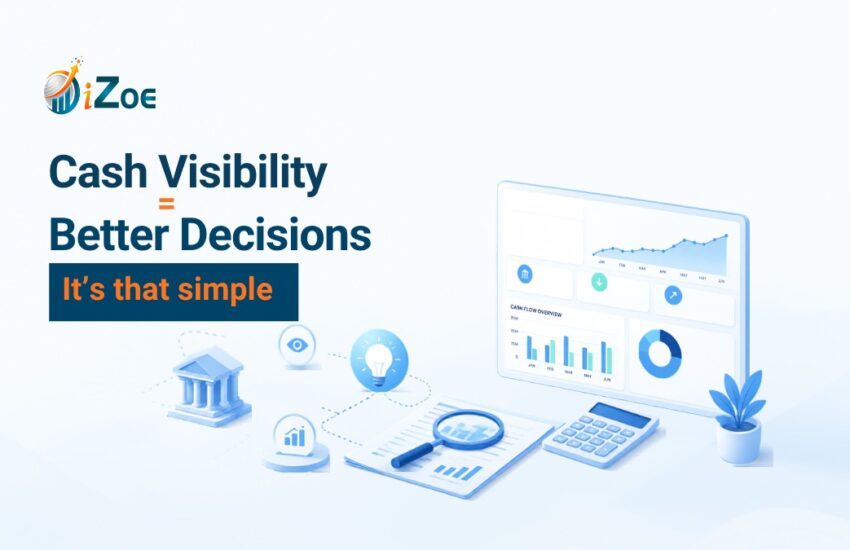
By connecting tools like Power BI or Tableau directly to your accounting system, you transform rows of numbers into visual narratives. Imagine opening a dashboard at 9:00 AM and seeing:
- Real-time Cash Position: Actual bank balances across all accounts.
- Net Working Capital: A live view of what is owed to you versus what you owe.
- DSO (Days Sales Outstanding): Identifying exactly which customers are dragging down your liquidity.
The goal here is “Drill-Down Capability.” If you see a dip in cash, you shouldn’t have to call your CFO. You should be able to click on the chart and see the specific pending invoices or unallocated expenses causing the dip.
Phase 3: Predictive Visibility and Exception Management
The final phase of the transition is moving from “What happened?” to “What will happen?” Advanced Business Intelligence (BI) tools allow you to layer external data onto your financial records.
For a manufacturing or distribution business, this means linking your inventory turnover rates with your cash outflow requirements. You can start running “What-If” scenarios. For example, if a major client delays payment by 15 days, how does that impact your ability to purchase raw materials for the next quarter?
With MIS reporting automation, you also shift to “Exception-Driven Finance.” Instead of checking every single voucher, the system alerts you only when a metric deviates from the norm. This frees up your mental bandwidth to focus on growth, partnerships, and market expansion.
Why the Phased Approach Wins
The biggest mistake founders make is trying to automate chaos. If you plug a sophisticated BI tool into a messy, manual accounting process, you simply get “garbage in, visual garbage out.”
By following a phased roadmap, you build a culture of data discipline. Your team learns to trust the system, your auditors find cleaner books, and you, the founder, finally get rid of the “Sunday night excelsheet dread.” Real-time MIS is not about having more data; it is about having more certainty. When you know exactly where your cash is, you can finally stop playing defense and start playing to win.
Frequently Asked Questions
1. Is my business too small for Business Intelligence tools like Power BI?
Not at all. If you have outgrown the ability to track your daily cash flow in your head or via a single excelsheet, you are ready. Modern BI tools are highly scalable and can be implemented for SMEs with revenues as low as ₹20 Crores to provide the same level of clarity enjoyed by large corporations.
2. How long does it take to move from Excel to a real-time dashboard?
Using a phased approach, you can often see the first set of automated visibility dashboards within 30 to 45 days. The key is to start with your most critical “pain point,” which for most founders is cash flow and AR/AP ageing.
3. How does iZoe help in this transition?
iZoe specializes in bridging the gap between messy raw data and CXO-grade insights. We don’t just give you a tool; we build the data pipeline. We integrate your existing accounting software with advanced BI platforms to ensure your dashboards are accurate, automated, and available on your mobile device.
4. Can iZoe help if our current data is unorganized?
Yes. Part of our core service involves cleaning up the data foundation. We help implement the necessary “controls” and automation layers to ensure that the information flowing into your new MIS is reliable and audit-ready.

