
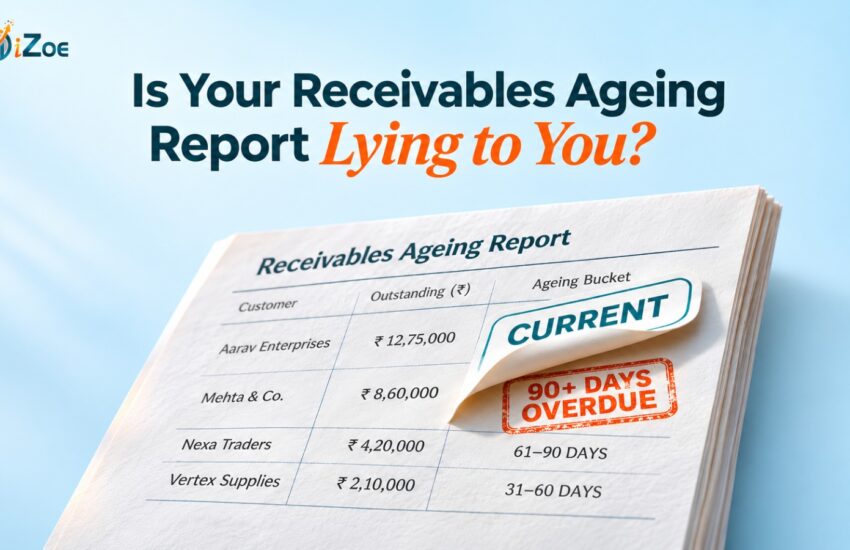
Every month, someone in finance sends the founder a receivables ageing report. The founder reviews the 0–30-day bucket, sees that most payments appear manageable, and moves on.
But has anyone checked whether the numbers are correct?
In many growing Indian businesses, receivables ageing reports become inaccurate because of unapplied receipts, unlinked credit notes, duplicate customer records, and incomplete reconciliations.
The problem is not always fraud. Often, it is a collection of small errors that go unnoticed. An inaccurate report can be more dangerous than no report because it creates confidence in numbers that may not reflect what customers actually owe.
A reliable receivables ageing report is not just a collection tool. It is a financial control that supports cash flow management, credit risk assessment, and better business decisions.
Why Do Receivables Ageing Reports Become Inaccurate?
Finance teams in trading and manufacturing businesses often manage four reconciliation challenges simultaneously: receivables, payables, inventory, and bank accounts.
These processes are interconnected. An unmatched bank receipt can leave an invoice appearing overdue. An inventory mismatch can delay billing, while an unresolved credit note can inflate outstanding receivables.
Here are five common reasons why receivables ageing reports become unreliable.
Unapplied customer receipts: A customer pays ₹12 lakh against three invoices, but the finance team cannot match the payment to the correct invoices. The receipt remains unadjusted while the invoices continue to appear outstanding. The sales team ends up chasing a customer who has already paid.
Incorrect ageing dates: Some businesses calculate ageing from the invoice date instead of the contractual due date. An invoice issued 40 days ago with 60-day payment terms may appear in the 31–60-day bucket, even though payment is not yet due.
Unlinked credit notes: Credit notes for sales returns, pricing differences, or short deliveries may not be adjusted against the original invoices. This makes reported outstanding balances inaccurate.
Unresolved disputes: A short-delivery or pricing dispute can remain outstanding for months without a clearly assigned owner or resolution date.
Duplicate customer records: The same customer may appear under different names across accounting software, branch-level Excel sheets, and CRM systems. This fragments balances and makes total customer exposure difficult to assess.
When these problems accumulate, the sales team, finance team, and founder may all work with different versions of the same financial position.
What Happens When Receivables Are Not Properly Reconciled?
The consequences extend beyond the collections department.
Inaccurate receivables ageing can distort cash flow forecasts, lead to ineffective collection follow-ups, weaken credit risk assessment, and complicate financial reporting.
Historical auditor reports illustrate why these controls matter.
An auditor’s report concerning Lakshmi Energy & Foods reported trade receivables of approximately ₹3,620.75 million, of which ₹3,261.86 million had reportedly been outstanding well beyond their due dates. Concerns were raised regarding recoverability and the absence of a provision.
For the year ended March 2020, auditors of Sujana Universal Industries reported difficulties verifying receivables because balance confirmations had not been received. The report also referred to substantial doubtful balances for which provisions had not been made.
These cases involve much larger businesses, but similar weaknesses can affect smaller distributors and manufacturers. Unconfirmed balances, unresolved differences, and inadequate provisions can create financial risks regardless of business size.
Verify these historical figures and descriptions against the original signed auditor reports before publication.
Why Accurate Receivables Ageing Matters to CFOs
Expected credit loss provisions: Under Ind AS 109, applicable entities must recognise expected credit losses on relevant financial assets. Trade receivables are often assessed using ageing-based provision matrices, adjusted for relevant historical and forward-looking information. Incorrect ageing can therefore affect credit risk assessments and reported profitability.
Bank finance: Banks may use eligible receivables to calculate drawing power under working capital facilities. Overdue, disputed, or otherwise ineligible balances may not qualify under the lending terms. Inaccurate ageing can create discrepancies during bank reviews.
Investor due diligence: Investors and potential acquirers examine debtor ageing, customer concentration, collection history, and reconciliation with the general ledger. Unexplained balances can raise concerns about working capital quality and financial reporting reliability.
For CFOs, accurate receivables ageing is essential for daily financial control as well as external reporting.
How Can CFOs Improve Receivables Ageing Accuracy?
Improvement starts with disciplined processes, clear ownership, and regular reconciliation.
- Age invoices by due date. Maintain agreed payment terms in the customer master and distinguish invoices that are outstanding from those that are actually overdue.
- Match receipts promptly. Reconcile bank receipts with open invoices as soon as possible. Assign an owner to unapplied receipts that remain unresolved beyond a defined period, such as seven days.
- Maintain one customer master. Use consistent customer identifiers across accounting software and other business systems. Review duplicate records before generating consolidated reports.
- Assign ownership to disputes. Record the reason, amount, responsible person, and expected resolution date for every significant disputed invoice.
- Reconcile monthly. Match the receivables ageing report with the general ledger, investigate differences, and review relevant GST records. Ask the sales head to review significant customer balances and collection expectations.
- Confirm material balances. Prioritise long-outstanding, disputed, and high-value receivables for customer balance confirmations. Regular reviews help identify discrepancies before an audit or bank assessment.
5. Can Accounting Automation Fix Receivables Ageing Problems?
Excel can support analysis, but manual reconciliation becomes difficult as transaction volumes and customer accounts grow.
Accounting software and automated accounting workflows can help standardise invoice ageing, match receipts, identify duplicate records, and flag unapplied payments. They can also support relevant GST and TDS validations, depending on the system and configuration.
However, automation cannot automatically correct poor customer records, missing payment terms, or unresolved disputes. These still require proper processes and review.
OCR (Optical Character Recognition) can extract information from invoices and remittance advice, but data extraction alone does not guarantee accounting accuracy.
The real value lies in combining automation with validation and exception checks.
This is the approach behind Akounter AI by iZoe. It combines invoice data extraction with automated accounting workflows and configurable checks to help finance teams identify discrepancies earlier.
By reducing repetitive data entry and surfacing exceptions, Akounter AI helps finance teams focus on resolving mismatches rather than spending excessive time processing documents.
The objective is to make financial records more consistent and reliable before they feed into receivables ageing reports and MIS reporting.
Can You Stand Behind Your Receivables Ageing Report?
A CFO should be able to explain which invoices are overdue, which balances are disputed, which receipts remain unapplied, and whether the report reconciles with the books of account.
That confidence comes from consistent accounting processes, timely reconciliation, clear ownership, and appropriate automation.
At iZoe, we help businesses improve accounting workflows through automation and validation checks that make discrepancies easier to identify and investigate.
If your receivables ageing report and collections team are telling different stories, it may be time to review the process behind your numbers.
Contact iZoe to explore how accounting automation can help strengthen your financial reporting controls.
Frequently Asked Questions (FAQs)
1. Why is my receivables ageing report inaccurate?
Common causes include unapplied receipts, incorrect ageing dates, unlinked credit notes, duplicate customer records, and incomplete reconciliations.
2. How often should receivables be reconciled?
At least monthly. Businesses with high collection volumes should review unapplied receipts and significant discrepancies more frequently.
3. Should receivables ageing be calculated from the invoice date or due date?
For monitoring overdue payments, ageing should generally be calculated from the contractual due date. Invoice age can be tracked separately.
4. Does accounting software fix receivables ageing problems?
Software can automate matching, calculations, and exception checks, but reliable results still depend on accurate records and consistent reconciliation.
5. Is OCR enough for automated accounting?
No. OCR extracts document data. Validation, duplicate detection, invoice matching, and exception handling are also necessary for reliable accounting.

